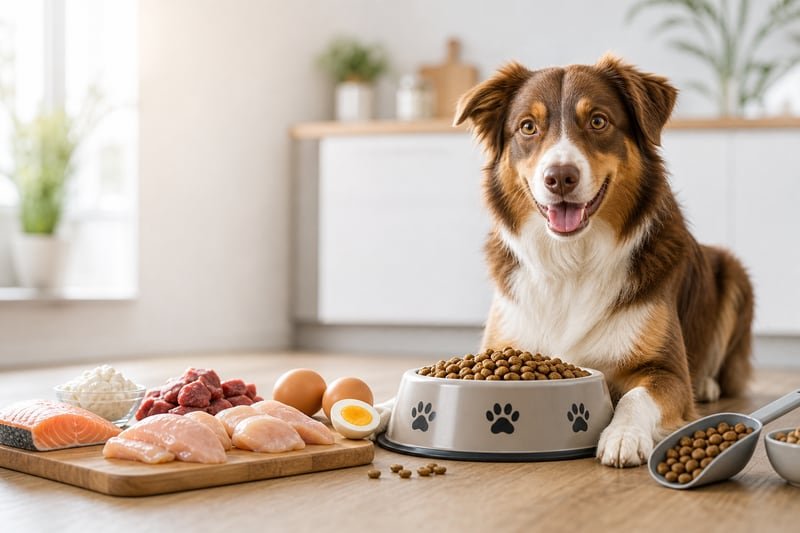
Is Merrick a Good Dog Food? A Balanced Review of Ingredients, Safety, and Value

Merrick recipes can differ substantially, so compare the complete label rather than judging the brand from one bag.
Merrick is marketed as a premium dog food brand, with named-meat recipes across grain-inclusive and grain-free kibble, wet food, puppy formulas, fresh-frozen meals, and limited-ingredient diets. That range is useful, but it also means the brand cannot be judged by one bag or one protein percentage.
For many healthy dogs, Merrick can be a good choice. The important question is whether the exact recipe matches your dog's age, size, health, activity level, body condition, and known sensitivities. Use the dog weight calculator to follow a weight trend, then pair the number with body-condition checks rather than treating either measure as a diagnosis.
QUICK VERDICT
Merrick can be a sound choice, but the recipe matters more than the logo
For a typical healthy adult without a medical reason to avoid grains, a grain-inclusive Merrick recipe labeled complete and balanced for adult maintenance is the most practical starting point. Compare calories, fat, fiber, proteins, and daily cost before buying.
- Strongest point
- Broad choice with clear recipe and calorie information
- Main caution
- Nutrition and calorie density vary substantially by recipe
- Best first check
- The exact bag's nutritional adequacy statement
Is Merrick really a good dog food?
Yes, Merrick is generally a reasonable premium option for many healthy dogs. It offers complete-diet recipes for different life stages and formats, publishes ingredient lists and calorie information, and states that its foods are developed by a team that includes animal nutritionists, PhDs, veterinarians, scientists, and engineers.
That is useful company information, not proof that every recipe is right for every dog. The WSAVA pet-food selection guide recommends looking beyond marketing to the formulator's qualifications, quality-control process, nutritional adequacy statement, calories, research, and manufacturer contact information.
Important AAFCO wording
Merrick states that its dog foods are formulated using AAFCO complete-and-balanced nutrient profiles. However, AAFCO does not approve or endorse individual pet foods. Read the nutritional adequacy statement on the exact product to see whether it is intended for adult maintenance, growth, reproduction, or all life stages.
What Merrick does well
- Useful variety: dry, wet, fresh-frozen, puppy, small-breed, grain-inclusive, grain-free, and limited-ingredient choices.
- Named animal proteins: many labels identify chicken, beef, salmon, lamb, turkey, or duck rather than relying only on a vague source.
- Accessible label details: Merrick publishes ingredients, guaranteed analyses, calorie content, feeding directions, and adequacy statements on product pages.
- Grain-inclusive alternatives: owners do not have to choose a grain-free recipe to stay within the brand.
- Multiple formats: dry, wet, and fresh-frozen options make it easier to account for preference and feeding style.
Who makes Merrick dog food?
Merrick is part of the Nestlé Purina family of brands. The company began in Hereford, Texas, and its current dog-food FAQ says Merrick foods and treats are crafted in facilities in the United States and Iceland.
Merrick also says its products are formulated by a team that includes trained animal nutritionists, PhDs, veterinarians, scientists, and engineers. Those qualifications are useful when evaluating a manufacturer, but they do not remove the need to check the adequacy statement, calories, and feeding directions on the exact formula.
Does "real meat first" prove quality?
No. Many Merrick products promote real meat as the first ingredient, which can be helpful for identifying a protein source, but it should not decide the purchase by itself. Federal rules require ingredients to appear in descending order by weight. Fresh meat contains substantial water, so its pre-processing position does not tell you what percentage of the finished food's protein it supplies.
Meat meals are not automatically low quality either. Removing much of the water and fat makes a meal a concentrated source of protein and minerals. What matters is the complete formula: nutritional balance, digestibility, calories, life-stage suitability, manufacturing controls, and how the dog responds.
Read the label in this order
- Nutritional adequacy: confirm that the food is complete and balanced for your dog's life stage.
- Calories: compare kcal per cup, can, tray, or kilogram, not just serving volume.
- Guaranteed analysis: review protein, fat, fiber, and moisture in context.
- Full ingredient list: look for known problem ingredients without judging the entire food by the first item.
- Feeding directions and cost: estimate the real daily portion and price for your dog.

Are grains in Merrick dog food bad?
No. Brown rice, barley, and oatmeal are not automatically "fillers." In a properly formulated diet, grains can supply energy, fiber, fatty acids, vitamins, and other nutrients. Most dogs do not need to avoid grains without an identified medical reason.
For a healthy adult that tolerates grains, a balanced grain-inclusive recipe is a sensible default. The more useful comparison is between two complete formulas that match the dog's life stage and calorie needs, not between the words "grain-free" and "with grains" on the front of the bag.
What about Merrick grain-free dog food?
Merrick sells grain-free recipes that use ingredients such as peas, lentils, potatoes, or sweet potatoes. These ingredients are not inherently dangerous. The concern is more specific: the FDA investigated reports of non-hereditary canine dilated cardiomyopathy (DCM) associated with diets that often placed pulse ingredients high on the ingredient list.
Merrick appeared among the brands named in the FDA's early 2019 case-report summary. That list recorded brands reported in submitted cases; it did not establish that Merrick caused DCM. FDA later said it would not keep updating the brand list because companies had changed formulations and the agency was still investigating a complex, multifactorial issue.
The FDA describes the issue as complex and multifactorial. Reports have involved both grain-free and grain-containing foods, and the agency has not concluded that pulses are inherently unsafe. Genetics, health, formulation, processing, ingredient proportions, nutrient availability, and feeding practices may all matter.
The practical approach is not to choose grain-free food as a healthier default. If your dog has a veterinarian-supported reason to use one, discuss the exact formula and long-term plan, especially when peas or other pulses appear high on the list or the dog has heart-disease risk factors. Added taurine alone does not settle every formulation question.

Is Merrick good for dogs with allergies?
Merrick's limited-ingredient recipes may help a dog avoid an ingredient that has already been identified as a problem. However, "limited ingredient" does not mean veterinary hypoallergenic, and changing retail foods repeatedly cannot diagnose a food allergy.
The current Limited Ingredient Diet Chicken & Brown Rice dry recipe lists 21% minimum protein, 14% minimum fat, and about 472 kcal per cup. That illustrates another important point: a shorter ingredient list is not automatically a lower-calorie food.
Dogs with recurring itching, ear infections, vomiting, diarrhea, or hair loss need a veterinary assessment because other conditions can look similar. The Merck Veterinary Manual identifies a strict dietary elimination trial followed by a controlled challenge as the reference standard. A veterinarian may select a hydrolyzed or genuinely novel-protein therapeutic diet and control every other food exposure during the trial.
A Merrick recipe may become a practical long-term option after the offending ingredient is known, but an over-the-counter limited-ingredient diet should not replace that diagnostic process.
Merrick pros and cons
| Pros | Cons |
|---|---|
| Clearly named animal proteins | Premium price |
| Grain-inclusive options available | Some formulas are calorie-dense |
| Recipes for different life stages | Grain-free recipes may rely heavily on pulses |
| Detailed ingredient and calorie information | Nutrition varies enough that the label must be checked recipe by recipe |
| Dry, wet, and fresh-frozen choices | Retail limited-ingredient food is not a veterinary hypoallergenic diet |
Calories, protein, and fat matter more than the scoop
Merrick dry recipes vary meaningfully in protein, fat, and calorie density. A higher protein percentage is not automatically better, and the same one-cup scoop can deliver very different calories depending on the recipe.
| Current dry recipe | Protein min. | Fat min. | Calories/cup | Calories in 2 cups |
|---|---|---|---|---|
| Grain Free Healthy Weight | 30% | 10% | 352 | 704 |
| Grain Free Chicken & Sweet Potato | 32% | 16% | 381 | 762 |
| Kitchen Comforts Beef & Brown Rice | 26% | 16% | 451 | 902 |
| Limited Ingredient Chicken & Brown Rice | 21% | 14% | 472 | 944 |
These are current label examples, not permanent values for every Merrick product. Formulas can change, so verify the bag before calculating portions.
Is Merrick Healthy Weight good for weight loss?
Merrick's Grain Free Healthy Weight recipe is lower in calories and fat than several standard dry recipes, which can make it easier to fit into a calorie-controlled plan. It does not guarantee weight loss: results still depend on total calories from meals, treats, chews, and table food.
Start with the package feeding guide, then adjust for body condition, activity, age, neuter status, and veterinary advice. Use the dog body condition score guide to assess ribs, waist, and abdominal tuck alongside the scale. If your dog is losing weight despite eating normally, or changes weight suddenly, treat that as a health question rather than solving it only with a richer or smaller portion.

Has Merrick dog food been recalled?
Yes. The clearest FDA-documented event relevant to current buyers is a 2018 voluntary recall covering limited production codes of certain Merrick and Castor & Pollux beef treats because of potentially elevated naturally occurring beef thyroid hormone. The FDA notice says the recall was completed and terminated.
That event affected specified treats, not the entire Merrick dry or canned food range. As of August 23, 2026, Merrick does not appear in the FDA's current animal recall table. This is a dated check, not a lifetime safety guarantee, so verify the current FDA recall list and the manufacturer's notices before relying on recall status.
How to interpret a recall record
A limited treat recall does not prove that every current Merrick food is unsafe. The absence of a current recall also does not prove that every recipe is nutritionally ideal for every dog. Check the affected product, date, lot codes, reason, and recall status.
Merrick for puppies, large breeds, and senior dogs
Is Merrick good for puppies?
Merrick offers puppy-specific recipes formulated for growth. Its current Grain Free Chicken & Sweet Potato Puppy dry food lists 28% minimum protein, 15% minimum fat, calcium, phosphorus, DHA, and about 400 kcal per cup. Choose it—or any puppy food—by the complete nutritional adequacy statement rather than by similar-looking ingredients on an adult bag.
For a puppy expected to weigh 70 pounds or more as an adult, confirm that the adequacy statement includes growth of large-size dogs. Controlled growth and an appropriate mineral balance matter more than maximizing protein or calories.
Is Merrick good for large-breed dogs?
Merrick offers large-breed adult recipes, including a current Grain Free Large Breed Chicken formula listing 30% minimum protein, 15% minimum fat, and about 462 kcal per cup. That adult formula should not be treated as interchangeable with food intended for a growing large-breed puppy.
Is Merrick good for senior dogs?
Merrick's current Grain Free Senior Chicken recipe lists 30% minimum protein, 12% minimum fat, about 382 kcal per cup, plus labeled glucosamine, chondroitin, and L-carnitine. Those features may suit some older dogs, but age alone does not identify the best diet.
“Senior” is not presently a separate AAFCO nutrient-profile life stage; AAFCO created a workgroup in 2026 to explore whether one should be added. For an older dog, weight trend, body condition, muscle condition, activity, dental health, and diagnosed disease are more useful than the word “senior” by itself.

Which Merrick formula may suit your dog?
| Dog or goal | Practical starting point | Check before buying |
|---|---|---|
| Typical healthy adult | Grain-inclusive adult-maintenance recipe | Calories, fat, fiber, proteins, portion, and daily cost |
| Puppy | Recipe labeled for growth or all life stages | Growth statement, calories, portions, and progress on a puppy weight chart by age |
| Large-breed puppy | Growth diet appropriate for the expected adult size | Calorie and mineral suitability; follow the large-breed puppy growth guide |
| Weight management | Controlled-calorie complete diet | Actual kcal per cup or can, fat, fiber, treats, and measured portions |
| Known sensitivity | Recipe excluding the confirmed trigger | Every protein and flavor source; veterinary guidance for diagnosis |
| Wet food or topper | Product matching the intended feeding role | Whether it is complete and balanced or for intermittent/supplemental feeding only |
Who should consider Merrick?
Merrick may be worth comparing for:
- healthy dogs whose owners want a premium dry, wet, or fresh-frozen option;
- dogs that do well on clearly identified animal proteins;
- owners looking for grain-inclusive and grain-free choices within one brand;
- dogs needing puppy, adult, small-breed, or limited-ingredient options;
- owners willing to compare calories and measure portions; and
- households that can afford the chosen recipe consistently.
Dogs with significant medical conditions, unexplained weight change, recurring digestive signs, suspected allergy, or heart disease should have their diet selected with veterinary guidance.
How to choose the right Merrick recipe
- Match the life stage. Find the nutritional adequacy statement before considering flavor or front-of-bag claims.
- Check the calories. Compare kcal per cup, can, tray, or kilogram to reduce accidental overfeeding.
- Review known problem ingredients. Read the whole list instead of focusing only on "meat first."
- Compare the full feeding picture. Look at protein, fat, fiber, portion size, calorie density, and estimated daily cost.
- Transition gradually. Mix increasing amounts of the new food with the old food over about seven to ten days; sensitive dogs may need longer.
- Monitor the response. Track appetite, stool, vomiting, itching, energy, and body weight. Contact your veterinarian if concerning signs persist or become severe.
COMMON QUESTIONS
Merrick dog food FAQ
Is Merrick a good dog food?
Merrick can be a good choice for many healthy dogs when the exact recipe matches the dog's life stage, calorie needs, health, and tolerance. A suitable grain-inclusive adult-maintenance recipe is a practical starting point for many healthy adults.
Is Merrick dog food AAFCO approved?
No pet food is AAFCO approved. AAFCO sets model standards but does not approve individual products. Merrick states that its dog foods are formulated using AAFCO complete-and-balanced nutrient profiles; buyers should verify the nutritional adequacy statement on the exact recipe.
Has Merrick dog food been recalled?
Yes. An FDA-documented 2018 recall covered limited production codes of certain Merrick and Castor & Pollux beef treats because of potentially elevated beef thyroid hormone. It did not cover the entire Merrick dry or canned food range.
Is Merrick grain-free dog food a good choice?
A grain-free Merrick recipe may suit a dog with a specific, veterinarian-supported reason to avoid grains, but grain-free is not automatically healthier. Discuss long-term use with a veterinarian, especially when pulses appear high on the ingredient list or the dog has heart-disease risk factors.
Is Merrick good for dogs with allergies?
A Merrick limited-ingredient recipe may help avoid an ingredient already known to cause a problem, but retail limited-ingredient food is not the same as a veterinary hypoallergenic diet. Suspected food allergy should be investigated with a veterinarian-guided elimination and challenge trial.
Who makes Merrick dog food?
Merrick is part of the Nestlé Purina family of brands. Merrick says its dog foods and treats are crafted in facilities in the United States and Iceland and formulated by a team that includes trained animal nutritionists, PhDs, veterinarians, scientists, and engineers.
Is Merrick good for puppies?
Merrick offers puppy recipes formulated for growth. Choose by the complete nutritional adequacy statement on the exact package, and for a puppy expected to weigh 70 pounds or more as an adult, confirm that the statement includes growth of large-size dogs.
Is Merrick worth buying?
Yes, Merrick can be worth buying for many dogs, but that conclusion applies to a suitable recipe, not automatically to everything carrying the brand name. Its strengths are breadth of choice, named animal proteins, grain-inclusive alternatives, useful label information, and formulation input from qualified nutrition professionals.
The main cautions are premium cost, meaningful variation between recipes, calorie density, and grain-free products that may place potatoes or pulses high on the ingredient list. Grain-free should not be treated as the healthier default, and retail limited-ingredient food should not replace a professionally managed allergy trial.
For a healthy adult without a veterinary reason to avoid grains, start by comparing a grain-inclusive Merrick recipe labeled complete and balanced for adult maintenance. Measure portions, transition slowly, track weight and body condition, and judge the food by how well it supports your individual dog rather than by marketing claims alone.
RESEARCH Research and references First-party product claims are separated from regulatory and veterinary guidance.
Reviewed August 23, 2026. Product ranges and formulas can change, so re-check the current label before feeding.
- Brand factsMerrick dog food FAQ Open source
- FormulationMerrick nutrition experts FAQ Open source
- Label standardsAAFCO consumer FAQ Open source
- Ingredient orderFDA animal food labeling Open source
- Food selectionWSAVA Global Nutrition Toolkit Open source
- Senior standardsAAFCO 2026 senior life-stage workgroup update Open source
- Grain-free contextFDA non-hereditary DCM Q&A Open source
- Food allergyMerck Veterinary Manual elimination-trial guidance Open source
- Recall recordFDA 2018 Merrick beef-treat recall Open source
- Current recallsFDA animal-food recalls and withdrawals Open source
Educational information only. This review is not veterinary advice, a prescription diet recommendation, or an endorsement of every product sold under the Merrick name.