How to Tell If Your Dog Is Overweight: Simple Signs Every Owner Can Check at Home
A lot of dogs do not become overweight all at once. It usually happens slowly. One extra treat here, a little less exercise there, and after some time, your dog starts looking slightly heavier without it feeling obvious in the beginning.
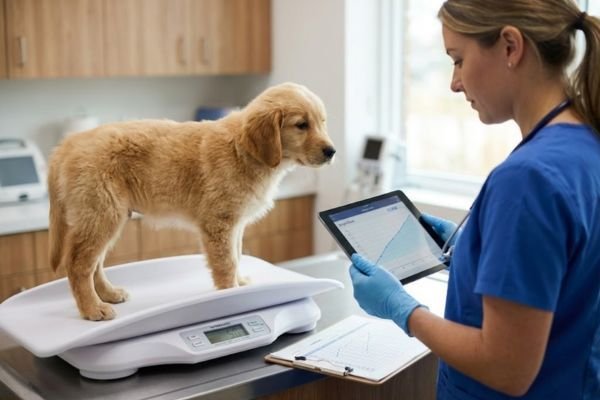
That is why so many dog owners miss the early signs. The good thing is that you do not need to make it complicated, and a dog weight calculator can also help you track your dog’s weight more clearly over time. In most cases, the easiest way to tell if your dog is overweight is to check three simple things: the ribs, the waist, and the tummy area. These small checks can tell you a lot about your dog’s body condition.
Why it Matters More than People Think
I think many people see extra weight in dogs as just a small appearance issue, but it is more important than that.
When a dog carries too much weight, it can make movement harder, put more pressure on the joints, reduce stamina, and make daily life less comfortable. Even if the change seems small in the beginning, it is still worth paying attention to.
In my opinion, it is always easier to deal with a small weight problem early than to wait until it becomes a much bigger issue, especially when you understand the healthy dog weight basics. That is why noticing the signs early really matters.
The Fastest Way to Check your Dog at Home
1) Feel your dog’s ribs
This is probably the best place to start.
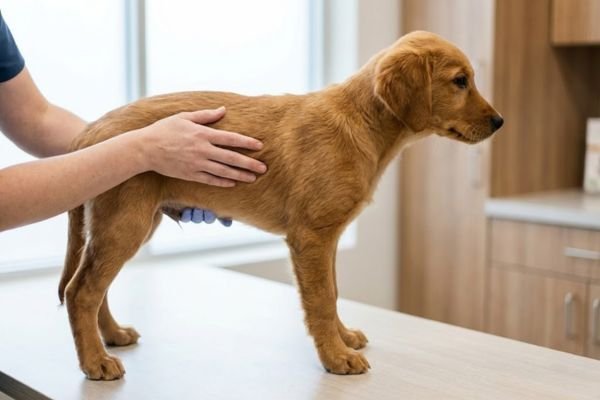
Gently place your hands over your dog’s rib area, just behind the front legs. You should be able to feel the ribs without pressing too hard. They should not stick out sharply, but they also should not feel buried under a thick layer of fat.
If you have to press down a lot just to feel them, that is often a strong sign your dog may be carrying extra weight.
I also think this is one of the most useful checks because your hands often tell you more than your eyes. Some dogs, especially fluffy ones, can look perfectly fine from the outside even when they are heavier than they should be.
2) Look at your dog from above
Stand above your dog and look down at their body.
A healthy dog usually has a visible waist behind the ribs. The body should narrow a little in that area instead of looking wide all the way through. It does not need to be a dramatic shape, but there should be some definition.
If your dog looks straight, round, or barrel-shaped from above, that can be a warning sign.
3) Look at your dog from the side
Now look at your dog from the side while they are standing.
The belly should usually rise upward a little from the chest toward the back legs. That gentle upward line is a good sign. If the belly hangs low, looks flat underneath, or seems round and heavy, that can suggest extra weight.
I think this side view helps a lot because it shows body changes that people often miss when they are only looking from the front.
What vets mean by body condition score
If you want a clearer way to understand your dog’s shape, body condition score can help.
What a dog body condition score means
In simple words, body condition score is just a way of judging whether your dog looks and feels too thin, healthy, or too heavy. You do not need to overthink it. The goal is simply to judge body shape in a more structured way instead of guessing.
What counts as ideal
A dog in a healthy condition usually looks lean without looking skinny.
You can feel the ribs fairly easily, the waist is visible from above, and there is a slight tummy tuck from the side. The dog looks fit and balanced rather than soft and round.
What 6/9 or 7/9 usually looks like in plain English
A slightly overweight dog usually starts losing that clean shape. The ribs become harder to feel. The waist becomes less obvious. The body starts looking softer and rounder than before. A clearly overweight dog usually has very little waist left, the belly may look heavier, and the ribs can be difficult to feel at all. At that stage, the extra weight is usually much easier to notice.
Signs owners often miss
Not every overweight dog looks obviously heavy. Sometimes the early signs are easy to miss.
Fat pads in certain spots
Extra fat does not always show up only around the belly.
Sometimes it starts showing around the neck, the hips, the lower back, or near the base of the tail. These areas may begin to feel thicker or softer before the overall body shape changes in a very obvious way.
Lower stamina
Another sign that can be easy to overlook is reduced stamina.
Your dog may seem slower on walks, get tired more quickly, pant more than usual, or show less excitement for activity. On its own, this does not always prove a weight issue, but together with body shape changes, it is something worth noticing.
“He still looks normal to me”
I think this is one of the biggest reasons people miss weight gain.
When you see your dog every day, your eyes slowly adjust. Small changes start to feel normal. That is why regular hands-on checks are much more useful than just relying on memory or visual habit.
When visual checks can fool you
Fluffy dogs
Fluffy dogs can be especially hard to judge.
A thick coat can hide a lot, so a dog may still look fine from the outside even when the ribs are harder to feel than they should be. That is why it is always better to use your hands and not rely only on appearance.
Naturally lean or deep-chested breeds
Not every dog is built the same way.
Some breeds naturally look slimmer, while others have a broader chest or a stronger tuck, which is why checking a Labrador Retriever weight chart or another breed-specific guide can be helpful. So instead of comparing your dog to every other dog, it makes more sense to ask whether your own dog still has a healthy shape for their build.
Puppies
Puppies can also be confusing.
Young puppies often have softer, rounder bodies while they are still growing, and giant breeds can be even more confusing, which is why a Great Dane weight chart can be useful for comparison. That does not always mean they are overweight. So if the dog is very young, it is important not to judge them too quickly by adult body standards.
A simple at-home sequence that works
If you want an easy routine, I would keep it simple and do this once a month:
- Place your hands over your dog’s ribs and see if you can feel them easily.
- Look down from above and check whether the waist is still visible.
- Look from the side and see whether the belly slopes upward.
- Feel around the neck, hips, lower back, and tail base for unusual softness or padding.
- Think about the overall body shape instead of relying only on the number on the scale.
This whole check only takes a couple of minutes but it can help you notice problems much earlier.
What to do if you think your dog is overweight
If your dog seems only a little overweight, I think the first step is to look honestly at food and daily habits.
When you can start with home changes
Ask yourself a few simple questions:
- Are meal portions too large?
- Are treats happening too often?
- Is someone in the house giving extra snacks?
- Has your dog been getting less exercise than before?
Sometimes the reason is very simple, and small changes in routine can make a real difference.
When to call your vet first
If the weight gain looks more serious, feels sudden, or your dog seems much less active than usual, I think it is a good idea to speak with a vet.
The same goes if you are unsure whether the problem is really just extra weight or something else. It is always better to ask early than to keep guessing.
Why guessing by breed weight charts alone is not enough
I do not think breed weight charts tell the full story.
Two dogs of the same breed can still carry weight very differently depending on their frame, muscle, age, and natural build. That is why body shape usually tells you more than focusing too much on one number.
Quick checklist: is your dog overweight?
Your dog may be overweight if:
- you cannot feel the ribs easily,
- the waist is hard to see from above,
- the belly does not tuck up from the side
- the body looks rounded or barrel-shaped
- fat pads have developed around the neck, back, hips, or tail base,
- and your dog tires more quickly than before.
Your dog is more likely at a healthy weight if:
- the ribs are easy to feel with light pressure,
- the waist is visible,
- the abdomen tucks upward
- and the body looks lean but not bony.
What to Remember
If you are wondering how to tell if your dog is overweight, do not start with the bathroom scale. Start with your hands and your eyes. Feel the ribs. Look for the waist. Check the tummy tuck. That simple routine is how many vets begin, and it is still the most practical way for owners to catch weight gain early. If the signs are mild, you can act sooner. If the signs are obvious you know it is time to call your vet and make a proper plan.