How Long Should a Dog Eat Puppy Food?

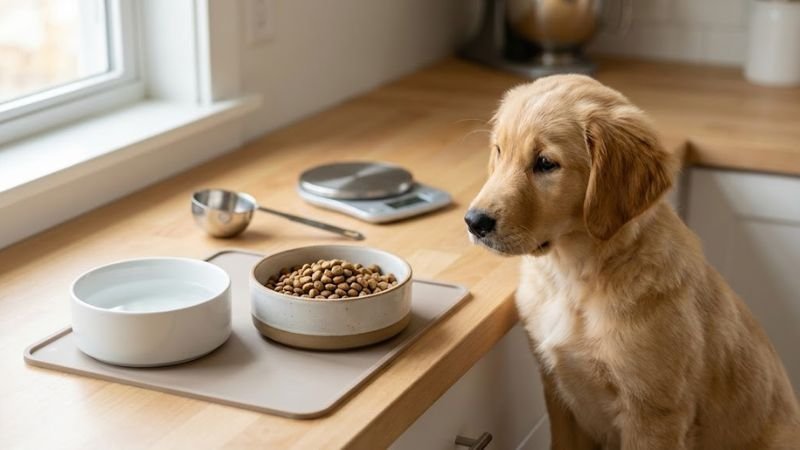
Puppies reach adult size and maturity on different schedules; the first birthday is not a universal deadline. Photo: Anna Tarazevich/Pexels.
A dog should eat puppy food until it is approaching skeletal and physical maturity, not simply until its first birthday. Small dogs often reach that point within the first year. Large dogs commonly take longer, and some giant breeds may continue developing into the second year.
The decision should combine expected adult size, the puppy's weight and growth trend, body condition, and the food's nutritional adequacy statement. A date on the calendar is only one clue.
QUICK ANSWER
Keep feeding an appropriate growth diet until maturity
Small and medium dogs are often ready for review around 8 to 12 months. Large dogs are commonly reviewed around 12 to 18 months, while some giant breeds may need a large-breed growth diet until roughly 15 to 24 months. These are discussion windows, not fixed deadlines.
When should a puppy stop eating puppy food?
Veterinary references use somewhat different ranges because “maturity” may refer to visible adult size, the end of rapid growth, or skeletal maturity. Merck Veterinary Manual notes that growth and skeletal maturity may be completed around 8 to 12 months in small and medium breeds and around 10 to 16 months in large and giant breeds. VCA uses broader physical-maturity ranges and notes that some giant breeds may take up to 24 months.
The practical synthesis below tells you when to review the diet with growth evidence in hand. It does not prescribe an automatic switch date.
| Expected adult size | Common review window | What to confirm |
|---|---|---|
| Toy or small | About 8-12 months | Growth has slowed and expected adult size is close |
| Medium | About 10-12 months | Weight trend and frame are becoming stable |
| Large | About 12-18 months | Skeletal growth is near completion |
| Giant | About 15-24 months | Large-breed growth stage is complete |
A dog can look tall and adult-like before the skeleton, chest, and muscle development are finished. When sources or package directions differ, ask the veterinarian following the puppy's actual growth.
INTERACTIVE PLANNER
Puppy-food transition readiness context
Compare age with a typical size-based review window and calculate how close the puppy is to an entered expected adult weight. Use the same unit for both weights.
- Entered adult weight reached
- —
- Common review window
- —
- Age context
- —
Not a switch recommendation: expected adult weight may be uncertain, and reaching a percentage does not prove skeletal maturity. Use growth history, the adequacy statement, and veterinary guidance.
Why do puppies need different food from adult dogs?
Growth and adult maintenance are different nutritional life stages. AAFCO recognizes gestation/lactation, growth, maintenance, and all life stages, and the nutritional adequacy statement identifies which stage a complete food is intended to support.
Growth diets are generally more nutrient dense and are designed to provide the energy and nutrients a developing puppy needs in an appropriate volume. Merck advises continuing a complete and balanced diet meant for growth until skeletal maturity, rather than stopping as soon as obvious height gain slows.
Do not try to turn an adult-maintenance diet into puppy food by adding calcium or other supplements. Merck notes that extra calcium, phosphorus, and vitamin D beyond a complete and balanced growth diet are rarely necessary and may be contraindicated.
How can you tell when a puppy is approaching adult-food readiness?
Use several signs together. None of these proves maturity on its own.
- Growth has slowed over repeated checks. Monthly gains are smaller than they were earlier in puppyhood, rather than changing suddenly after one measurement.
- Current weight is near a credible adult estimate. Merck says a less nutrient-dense diet is generally considered after a dog reaches about 90% of expected adult weight. An estimate is useful context, not a diagnosis.
- Height changes are becoming smaller. Height may settle before the chest and muscle finish filling out, so appearance alone can be misleading.
- Body condition remains appropriate. A visible waist and easily felt ribs are more useful than pushing for the fastest possible weight gain. Follow a consistent dog body condition score method.
- A veterinarian agrees growth is nearly complete. This is especially important for large and giant breeds, puppies with unusual growth, and dogs eating therapeutic diets.
Track the trend with the puppy weight calculator and puppy growth chart, but use the veterinarian's examination for the final dietary decision.
What should large- and giant-breed owners look for on the label?
Large and giant puppies need particular attention to controlled growth and mineral balance. For a dog expected to weigh 70 lb (32 kg) or more as an adult, read the complete nutritional adequacy statement—not just the word “puppy” on the front.
LABEL CHECK
For a growth or all-life-stages food, look for wording that says it is appropriate including growth of large-size dogs (70 lb or more as an adult).
If the statement instead says except for growth of large-size dogs, it is not labeled to support that use.
Large-breed puppies should remain on an appropriate complete and balanced growth diet until their longer growth period is complete. Do not move them to ordinary adult-maintenance food early just because they already look large.
What happens if you switch to adult food too early?
Adult-maintenance food is designed for a different life stage. Switching before skeletal maturity can place a growing dog on a nutrient profile that is not intended to meet growth requirements. The concern is greatest when a large or giant puppy is moved away from a diet specifically labeled for large-size growth.
Check the adequacy statement on the exact recipe. Marketing names such as “junior,” “premium,” or “natural” do not replace the life-stage statement.
Can a puppy eat food labeled for all life stages?
Some all-life-stages foods meet growth requirements, so changing formulas at maturity is not always mandatory. However, “all life stages” is not the same as “ideal portion for every stage.” AAFCO says these products should provide separate feeding directions for growth and maintenance.
For large puppies, the statement must also include large-size growth rather than exclude it. Once growth ends, follow the maintenance directions and monitor calorie intake and body condition.
What happens if you feed puppy food too long?
Puppy food does not become harmful on a birthday. The practical concern is that a growth diet may be more calorie dense than a mature, less active dog needs. If the same portion continues after growth slows, weight gain can become easier.
Watch the dog's weight trend, waist, rib coverage, appetite, and activity. If body condition rises after growth is largely complete, review both the formulation and the amount being fed.
How do you switch from puppy food to adult food?
Once the timing and new food are appropriate, change gradually. VCA recommends a transition over approximately seven to 14 days to reduce digestive upset. Dogs with sensitive stomachs may need a slower schedule.
| Stage | Puppy food | Adult food |
|---|---|---|
| Beginning | 75% | 25% |
| Middle | 50% | 50% |
| Later | 25% | 75% |
| Complete | 0% | 100% |
Those percentages describe stages, not one stage per day. Divide them across the time that suits the dog's tolerance. Slow down and contact a veterinarian if vomiting, persistent diarrhea, reduced appetite, or discomfort develops.

Should you change meal frequency at the same time?
Not necessarily. Merck's general guidance uses three daily meals from weaning to six months, followed by twice-daily feeding around six to 12 months. Individual needs vary, and very small puppies may need more frequent feeding.
Keeping meal timing stable during a formula change makes digestive responses easier to interpret. There is no need to change the food, meal frequency, bowl, and portion all on the same day.
What if you do not know the puppy's expected adult size?
Mixed-breed puppies can make transition timing less obvious. Start with current age, current weight, repeated growth rate, body frame, and parent size when known. A puppy adult-weight estimate can suggest a size group, but repeated measurements are more useful than one prediction.
If the puppy sits between size groups or the estimated adult weight keeps changing, a veterinary assessment is safer than choosing the earlier window. The when dogs stop growing guide explains why height, weight, and later body fill do not finish simultaneously.
When should you ask a veterinarian?
Ask for individual guidance when the puppy's growth does not follow the expected pattern or when physical maturity is uncertain. Seek veterinary advice if the puppy:
- gains weight unusually quickly or stops gaining during active growth;
- looks underweight, overweight, or loses muscle;
- has repeated vomiting, diarrhea, or appetite changes;
- has an orthopedic, gastrointestinal, metabolic, or other medical condition;
- needs a therapeutic diet; or
- is a large or giant breed and the label or timing is unclear.
A veterinarian can interpret body condition, growth stage, expected adult size, and the exact food together—something age alone cannot do.
COMMON QUESTIONS
Puppy food transition FAQ
At what age should a dog stop eating puppy food?
Switch after the dog is approaching skeletal and physical maturity, not automatically on the first birthday. Small dogs are often reviewed around 8 to 12 months, while large and giant dogs may need an appropriate growth diet longer.
Can a one-year-old dog still eat puppy food?
Yes. A one-year-old large or giant dog may still be growing and may still need a complete and balanced growth diet appropriate for large-size dogs. Confirm timing with growth history and veterinary guidance.
What happens if you switch to adult dog food too early?
An adult-maintenance food is not designed to meet the same life-stage requirements as a growth food. Switching before skeletal maturity can leave a growing puppy on an unsuitable nutrient profile.
Can a puppy eat food labeled for all life stages?
Some can. For a dog expected to weigh at least 70 lb as an adult, verify that the adequacy statement includes growth of large-size dogs instead of excepting them.
How slowly should you switch to adult food?
Seven to 14 days is a common veterinary recommendation. Slow the change if mild digestive signs appear and contact a veterinarian if they persist or are severe.
Is puppy food bad for adult dogs?
It does not suddenly become harmful, but growth food may be more calorie dense than a mature dog needs. Feeding too many calories after growth can contribute to excess weight.
RESEARCH Research and veterinary references Growth timing, label language, body-condition monitoring, and transition advice were checked separately.
Fact-checked August 21, 2026. A puppy's growth pattern and a food's formulation can differ, so use the current package and individual veterinary advice.
- Growth nutritionMerck Veterinary Manual: Feeding Practices in Small AnimalsOpen source
- Food labelsMerck Veterinary Manual: Dog and Cat FoodsOpen source
- Life stagesAAFCO: Selecting the Right Pet FoodOpen source
- Maturity rangesVCA: When to Switch Puppy to Adult FoodOpen source
- Food transitionVCA: Switching a Pet to Adult Wellness FoodOpen source
- Nutrition assessmentAAHA: Nutritional Assessment Across Canine Life StagesOpen source
Use the age window as a review point
Track growth and body condition, read the complete adequacy statement, and make the final switch when the puppy's development supports it.